Mortgage Rates Above 7%: Should Buyers Consider an ARM or Rate Buydown?
Mortgage Rates Above 7%: Should Buyers Consider an ARM or Rate Buydown?
With mortgage rates back above 7%, many buyers are asking the same question:
Is there another way to lower the payment?
That question is bringing adjustable-rate mortgages, temporary rate buydowns and other financing strategies back into the conversation.
These options can absolutely be useful for the right borrower.
But there is an important distinction:
A lower payment today does not automatically mean a better mortgage long term.
The right financing strategy depends on how long you expect to own the home, your future plans, your available cash, your income and how comfortable you are with the possibility of a changing payment.
Buyers Are Looking Beyond the Traditional 30-Year Fixed Mortgage
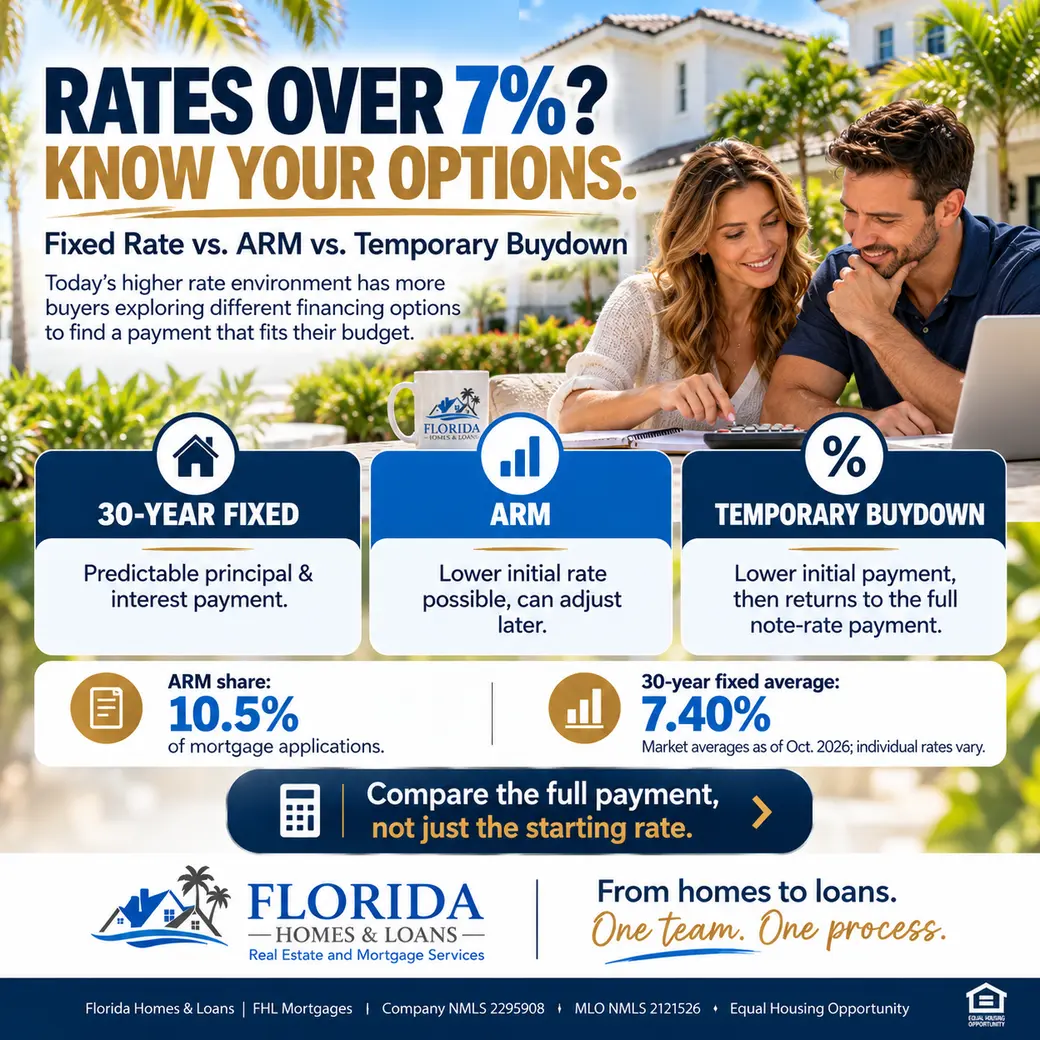
The 30-year fixed mortgage is popular for a simple reason: predictability.
Once the mortgage closes, changes in market interest rates do not change the principal-and-interest payment.
But when fixed mortgage rates rise, buyers naturally start comparing alternatives that could provide a lower starting rate or payment.
Adjustable-rate mortgages have recently accounted for a larger share of mortgage applications as buyers look for ways to manage affordability.
That does not mean everyone should switch to an ARM.
It means buyers should understand that the 30-year fixed mortgage is not the only financing structure available.
What Is an Adjustable-Rate Mortgage?
An adjustable-rate mortgage, or ARM, generally begins with an interest rate that is fixed for a specified period.
After that introductory period, the rate can adjust according to the terms of the mortgage.
For example, a 7/6 ARM generally means:
-
The initial interest rate is fixed for seven years.
-
After those seven years, the rate may adjust every six months.
A 5/6 ARM would generally have a fixed rate for five years before becoming eligible for adjustments every six months.
Because the lender is not guaranteeing the same interest rate for 30 years, an ARM may offer a lower introductory rate than a comparable fixed-rate mortgage.
That can create a lower initial monthly payment.
But the borrower takes on something a fixed-rate borrower does not:
Future interest-rate risk.
When Could an ARM Make Sense?
An ARM can potentially be useful for someone who:
-
Expects to relocate within several years.
-
Is purchasing a starter home they do not expect to keep long term.
-
Anticipates a meaningful increase in income.
-
Has strong financial reserves.
-
Understands how the mortgage can adjust.
-
Can comfortably handle the potential future payment.
The important part is not simply looking at the introductory rate.
Before choosing an ARM, buyers should understand exactly what could happen after the fixed period expires.
Questions to Ask Before Choosing an ARM
Ask your mortgage professional:
How long is the initial rate fixed?
Five years? Seven years? Ten years?
When can the rate first change?
Know the date before closing.
How frequently can it adjust?
Some ARM products may adjust every six months after the introductory period.
What index and margin determine the future rate?
These help determine how the adjusted interest rate will be calculated.
What are the adjustment caps?
ARMs typically limit how much the rate can change at the first adjustment, subsequent adjustments and over the life of the loan.
And perhaps most importantly:
What is the highest payment this mortgage could potentially reach?
If that number would create a serious financial problem, the lower introductory payment may not be worth the risk.
What Is a Temporary Rate Buydown?
A temporary rate buydown works differently from an ARM.
The mortgage itself has a regular note rate.
Funds contributed at closing are used to temporarily reduce the borrower's payment during the beginning of the mortgage.
Common examples include 1-0 and 2-1 buydowns.
How a 1-0 Buydown Works
Suppose the mortgage note rate is 7.25%.
With a properly structured 1-0 temporary buydown:
Year 1: The payment is calculated using an effective rate of 6.25%.
Year 2 and afterward: The payment is based on the full 7.25% note rate.
The borrower does not actually have a permanent 6.25% mortgage.
The payment difference during the first year is being subsidized by the buydown funds.
How a 2-1 Buydown Works
Using the same 7.25% note-rate example:
Year 1: Payment based on an effective rate of 5.25%.
Year 2: Payment based on an effective rate of 6.25%.
Year 3 onward: Payment based on the full 7.25% note rate.
This can help ease the transition into homeownership, particularly when the buyer expects income to increase or wants additional breathing room during the first year or two.
However, the buyer should be comfortable with the full payment from the beginning.
Who Can Fund a Temporary Buydown?
Depending on the mortgage program and transaction, an eligible seller, builder or other permitted party may be able to contribute funds toward a temporary buydown.
This can become especially useful when a seller is motivated.
Instead of simply reducing the purchase price, the seller may be able to contribute toward a strategy that lowers the buyer's initial payment.
Which option is better depends on the numbers.
A price reduction may benefit one buyer.
A closing-cost credit may benefit another.
A rate buydown may be more valuable to someone else.
That is why financing should ideally be discussed before the purchase offer is written.
Temporary Buydowns Do Not Qualify You for a Home You Cannot Afford
This is an important point.
The reduced introductory payment is temporary.
On many conventional mortgages, the borrower must still qualify using the full note rate rather than the temporarily reduced payment.
Buyers should approach their personal budget the same way.
Ask:
Can I comfortably afford this mortgage when the buydown expires?
If the answer is no, the temporary payment reduction does not fix the underlying affordability issue.
ARM vs. Temporary Buydown
Although both can lower the initial payment, they work very differently.
Adjustable-Rate Mortgage
An ARM may provide a genuinely lower interest rate during the introductory fixed period.
After that period, the rate can adjust.
Primary benefit: Potentially lower initial rate and payment.
Primary risk: Future payment uncertainty.
Temporary Buydown
The mortgage note rate remains the same, but the first payments are partially subsidized.
The future full payment is already known.
Primary benefit: Reduced payment during the beginning of the mortgage.
Primary risk: The borrower must be prepared for the predetermined payment increase.
Neither option is automatically better.
They solve different problems.
What About Permanently Buying Down the Rate?
Another option is paying discount points to obtain a permanently lower mortgage rate.
Unlike a temporary buydown, the reduced rate generally continues for the life of the mortgage unless the borrower sells, refinances or pays off the loan.
But there is an upfront cost.
The question becomes:
How long will it take the monthly savings to recover the amount paid upfront?
For example, if paying points costs $6,000 and lowers the payment by $100 per month, the approximate break-even point would be five years.
If you expect to sell or refinance before then, paying those points may provide less benefit.
If you expect to keep the mortgage for many years, the calculation could look very different.
Seller Credits Can Be Part of the Financing Strategy
In today's market, seller concessions can be valuable.
Depending on the loan program and applicable contribution limits, seller credits may potentially help pay eligible:
-
Closing costs
-
Prepaid expenses
-
Temporary buydowns
-
Discount points
This is why buyers should not automatically negotiate only on price.
Imagine negotiating $10,000 from a seller.
Would you rather:
Reduce the purchase price by $10,000?
Use eligible funds to reduce cash needed at closing?
Use some toward a temporary buydown?
Use some toward discount points?
The correct answer depends on the buyer.
Your mortgage professional can run the scenarios before the offer is submitted.
What About Interest-Only Loans?
Interest-only mortgages are another product sometimes discussed when buyers are trying to reduce the initial payment.
They may be available through certain non-QM programs.
During an interest-only period, the borrower may make payments that do not reduce the principal balance.
That produces a lower required payment during that period.
However, once the interest-only period expires, the borrower may begin paying principal and interest over the remaining term.
That can result in a significant payment increase.
Interest-only financing can have appropriate uses for certain borrowers and investors.
But it should not be used simply to make an otherwise unaffordable property appear affordable.
Don't Choose a Mortgage Based Only on the Lowest Payment Today
Imagine three options.
Option A: A 30-year fixed mortgage with a predictable payment.
Option B: An ARM with a lower introductory rate but future adjustment risk.
Option C: A fixed-rate mortgage with a temporary buydown.
Which one is best?
We cannot answer that without knowing:
-
How long you expect to own the home.
-
Your available savings.
-
Your expected future income.
-
Your comfort level with payment changes.
-
Seller concessions available.
-
Mortgage rates and loan costs.
-
Your likelihood of refinancing.
-
The cost of obtaining the lower rate.
The mortgage with the smallest first payment is not automatically the best mortgage.
Do Not Build the Plan Around Refinancing
A common thought is:
“I'll take the lower introductory option now and refinance when rates come down.”
That may eventually work.
But future mortgage rates cannot be guaranteed.
A future refinance will also depend on your:
-
Income
-
Employment
-
Credit
-
Property value
-
Equity
-
Mortgage guidelines at that time
There will generally also be costs associated with refinancing.
Refinancing should be viewed as a future opportunity—not something the current mortgage depends on in order to remain affordable.
Higher Rates Can Create Opportunities in the Real Estate Negotiation
There is another part of this conversation that buyers should not overlook.
Higher mortgage rates can reduce buyer competition.
That may create more opportunities to negotiate:
-
Purchase price
-
Seller credits
-
Repairs
-
Rate buydowns
-
Closing dates
-
Other contract terms
Sometimes the best mortgage strategy actually begins with the real estate offer.
This is one advantage of having your real estate and mortgage professionals working together before negotiations begin.
What Florida Buyers Should Do Before Choosing an ARM or Buydown
Start With Your Comfortable Payment
Determine the complete housing payment that works within your actual monthly budget.
Do not begin with the maximum amount a lender says you qualify for.
Compare Multiple Mortgage Options
Ask to see scenarios for:
-
30-year fixed
-
Available ARM options
-
Temporary buydowns
-
Permanent rate reductions
-
Conventional
-
FHA
-
VA
-
USDA
-
Applicable non-QM programs
Look at the Future Payment
Do not stop at the first-year number.
For an ARM, understand the potential adjusted payment.
For a temporary buydown, understand exactly what the payment becomes when the subsidy expires.
Compare Cash Needed at Closing
A lower rate requiring substantially more money upfront may not necessarily be the better option.
Keep Emergency Savings
Do not empty your savings account simply to achieve a slightly lower mortgage payment.
Homes require maintenance and unexpected expenses happen.
Consider Your Expected Ownership Period
How long you realistically expect to own the property can materially change which mortgage strategy makes the most sense.
The Bottom Line
Mortgage rates above 7% are forcing buyers to think differently about financing.
That isn't necessarily a bad thing.
A traditional 30-year fixed mortgage is not automatically the best option for every borrower.
Neither is an ARM.
Neither is a temporary buydown.
The best strategy is the one that fits your:
Budget.
Future plans.
Risk tolerance.
Cash position.
Expected time in the home.
Instead of asking:
“Which mortgage gives me the lowest payment right now?”
Ask:
“Which mortgage makes the most sense for the time I expect to own this home?”
At Florida Homes & Loans, our real estate and mortgage teams can evaluate the transaction together.
That means we can look at the property, seller concessions, mortgage programs, cash needed to close and future payment before you decide how to structure the offer.
One team. One process. From homes to loans.
This article is provided for general educational purposes only and is not individualized financial advice or a commitment to lend. Mortgage rates, ARM terms, adjustment caps, temporary buydown eligibility, seller-contribution limits, interest-only products and qualification requirements vary by borrower, lender, property and loan program. Adjustable-rate mortgages may result in higher future payments. Temporary buydowns do not permanently reduce the mortgage note rate. Not all products are available to all borrowers. All loans are subject to credit and property approval. Equal Housing Opportunity. Florida Homes & Loans Inc. | FHL Mortgages | Company NMLS 2295908 | MLO NMLS 2121526.
Sources: Homes.com News, Mortgage Bankers Association and Freddie Mac.
Categories
Recent Posts