Are Starter Homes Finally Making a Comeback?
From homes to loans.
Are Starter Homes Finally Making a Comeback?
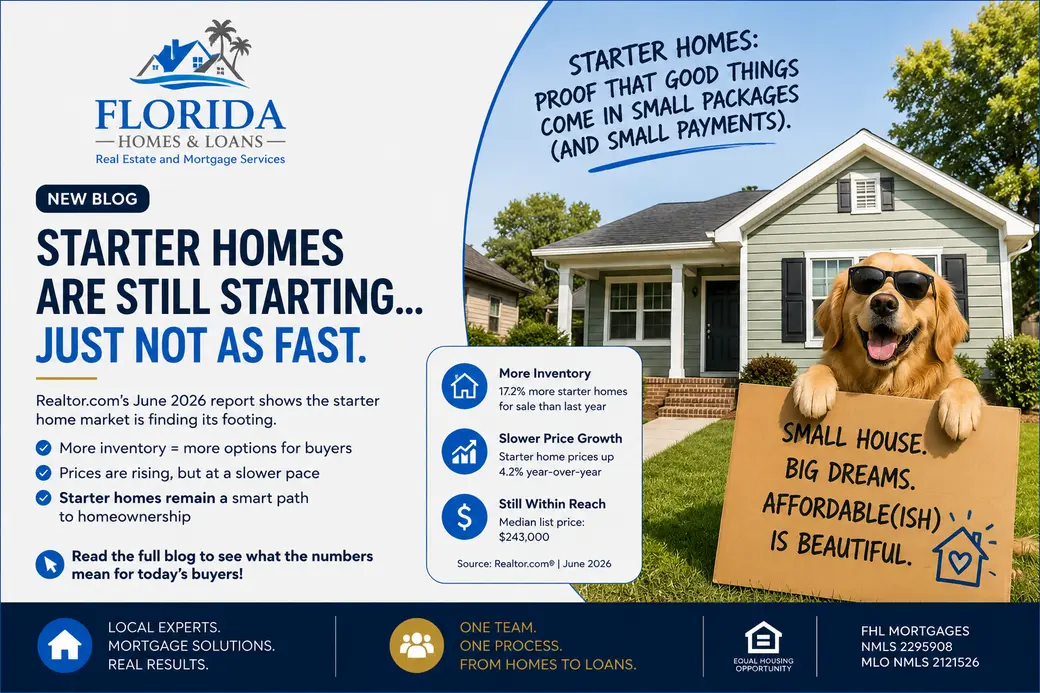
More lower-priced homes are reaching the market, especially across the South—but affordability remains a major challenge for first-time buyers.
For several years, first-time buyers have faced a frustrating combination: too few affordable homes, rapidly rising prices and mortgage payments that climbed much faster than household incomes.
The latest housing research provides some cautious good news. The starter-home market is beginning to improve, particularly across the South.
More lower-priced properties are available than during the worst of the pandemic-era shortage. Buyers in some markets may also have more time to compare homes, negotiate repairs and request assistance with closing costs.
However, an improving market does not mean starter homes have returned to their pre-pandemic prices or availability.
What Is Considered a Starter Home?
A starter home is not defined only by its square footage, age or number of bedrooms.
Realtor.com’s research defines a starter-home price threshold as approximately 80% of an area’s median listing price. The report also tracks the share of homes priced below $350,000 to measure the availability of homes that may be accessible to entry-level buyers.
Depending on the local market, a starter home may be:
- A smaller detached single-family home.
- A townhome or condominium.
- An older property with dated finishes.
- A home farther from a major employment center.
- A property with fewer bedrooms or less outdoor space.
- A smaller new-construction floor plan.
A first home does not need to be a forever home. The goal is to find a safe, financially sustainable property that meets the buyer’s most important needs and provides a reasonable path into homeownership.
The Starter-Home Shortage by the Numbers
Although inventory has improved since 2022, the national starter-home market remains considerably tighter and more expensive than it was before the pandemic.
Approximately 300,000 fewer homes priced below $350,000 are available nationally than before the pandemic.
The typical national starter-home price in 2026, compared with approximately $256,000 in 2019.
Approximate household income needed to purchase the typical starter home, up from about $43,000 in 2019.
In June 2019, approximately 55.1% of active listings nationally were priced below $350,000. By 2026, that share had fallen to 37.6%.
The typical starter-home price increased by approximately $88,000 during the same period.
How the Starter-Home Market Became So Difficult
The entry-level market experienced two major shocks.
First, pandemic-era demand increased while the number of available homes fell sharply. Buyers competed aggressively for a limited supply, pushing prices higher.
Mortgage rates then increased. Many existing homeowners had already secured considerably lower rates and became reluctant to sell, further limiting the number of properties reaching the market.
Realtor.com reported that approximately 67% of outstanding mortgages carried rates of 5% or less.
Home prices remained elevated while financing became more expensive. As a result, the estimated income needed to purchase the typical starter home increased by more than 80% from 2019 to 2026.
The Good News: More Affordable Homes Are Reaching the Market
Conditions have improved since the starter-home market reached its most difficult point in 2022.
Nationally, approximately 220,000 more homes priced below $350,000 are available than at the 2022 low. Typical starter-home prices have also declined from their peaks in certain regions.
The South has experienced the strongest inventory recovery. New construction in Florida, Texas and the Carolinas has helped bring nearly 170,000 more affordably priced listings to the market compared with the pandemic-era low.
The share of Southern listings priced below $350,000 improved from 39.8% in 2023 to 43.6% in 2026.
For Florida buyers, improving inventory may mean more choices, fewer extreme bidding situations and greater opportunities to negotiate repairs, concessions or closing-cost assistance. Conditions still vary considerably by city, neighborhood and price range.
More Inventory Does Not Automatically Mean Affordable
An increase in listings does not guarantee that buyers can qualify for those homes.
Sales of homes priced below $350,000 remained weak in 2026 even as inventory improved. Many entry-level buyers continue to struggle with mortgage qualification and the complete monthly cost of ownership.
A buyer’s estimated housing expense may include:
- Principal and interest.
- Property taxes.
- Homeowners insurance.
- Flood insurance, when required.
- Mortgage insurance.
- Homeowners or condominium association fees.
- Maintenance and repairs.
This is particularly important in Florida, where insurance, property taxes and association costs can cause two similarly priced homes to produce very different monthly payments.
A $325,000 home with high insurance premiums and association fees may cost more each month than a $350,000 home with a newer roof, lower insurance and no monthly association fee.
The listing price is only the starting point.
The Starter Home May Look Different Today
Buyers may find more opportunities by expanding their definition of what a first home should look like.
Features that can be changed
- Paint colors and flooring.
- Cabinet hardware and fixtures.
- Landscaping.
- Dated but functional finishes.
- Cosmetic updates completed over time.
Issues that affect affordability
- The complete monthly payment.
- Roof and major-system condition.
- Insurance eligibility and cost.
- Property taxes and association expenses.
- Location and long-term suitability.
Paint, cabinets and landscaping can be updated. An unaffordable payment is much harder to correct.
What Florida First-Time Buyers Should Do Now
An improving inventory environment gives buyers more room to plan before beginning the home search.
1. Begin With the Payment
Ask for several financing scenarios showing different purchase prices, down payments and loan programs.
The buyer should understand the complete estimated payment—not only principal and interest.
2. Compare More Than One Loan Program
Depending on eligibility, possible options may include:
- Low-down-payment conventional financing.
- FHA financing.
- Eligible VA or USDA zero-down financing.
- Down-payment or closing-cost assistance.
- Temporary or permanent interest-rate buydowns.
- Seller-paid closing costs.
- Eligible gift funds.
The loan with the lowest down payment is not automatically the least expensive option. Compare the payment, mortgage insurance, cash needed to close and long-term cost.
3. Review Insurance Early
Roof age, electrical equipment, plumbing materials and wind-mitigation features may materially affect the insurance premium.
An insurance quote should be part of the property evaluation, not an afterthought shortly before closing.
4. Estimate the Buyer’s Future Property Taxes
The seller’s current tax bill may reflect years of homestead assessment protection.
Buyers should review an estimated tax amount based on the anticipated purchase price and their expected exemptions.
5. Keep Emergency Reserves
Using every available dollar for the down payment can leave a new homeowner financially exposed.
Buyers should also budget for moving expenses, insurance deposits, utility connections, repairs and unexpected maintenance after closing.
A responsible starter-home budget should include:
- The complete estimated mortgage payment.
- Estimated taxes based on the purchase price.
- Homeowners and flood-insurance estimates.
- Association dues and possible assessments.
- Inspection and closing expenses.
- Immediate repair or improvement costs.
- Emergency reserves remaining after closing.
What Sellers of Entry-Level Homes Should Know
Owners selling homes in starter-home price ranges may benefit from improving buyer choice, but today’s buyers remain highly payment-conscious.
Sellers can make their properties more competitive by addressing issues that affect financing or insurability, including:
- Roof condition.
- Electrical-panel concerns.
- Active leaks or plumbing issues.
- Unpermitted additions.
- Safety problems.
- Major deferred maintenance.
Sellers may also consider offering closing-cost assistance or a temporary interest-rate buydown instead of relying only on a price reduction.
For some buyers, reducing the amount needed at closing or lowering the introductory payment may be more helpful than a modest reduction in the asking price.
The Market Is Improving, but Strategy Still Wins
The worst of the starter-home shortage may be behind us, especially in parts of the South.
However, the market remains considerably more expensive than it was before the pandemic. Nationally, only 37.6% of active listings were priced below $350,000 in June 2026, compared with 55.1% in 2019.
Buyers should not build their plans around the assumption that prices will suddenly return to 2019 levels.
A more practical approach is to understand the current numbers, explore suitable financing options and be prepared when the right opportunity reaches the market.
Florida Homes & Loans helps buyers evaluate the complete picture—from finding the property to comparing mortgage programs, estimating the cash needed to close and understanding the projected monthly payment.
Thinking About Buying Your First Home?
Let us review your available mortgage programs, estimated payment and cash-to-close requirements before you begin the home search.
Information Source
This article is provided for general educational purposes only and is not a commitment to lend, financial advice or a guarantee of future housing-market conditions. Mortgage programs, rates, property taxes, insurance premiums and qualification requirements vary by property and borrower. All financing is subject to credit approval, underwriting requirements and program availability. Equal Housing Opportunity. Florida Homes & Loans Inc. | FHL Mortgages | Company NMLS 2295908 | MLO NMLS 2121526.
Categories
Recent Posts