
Florida Homestead Exemption Proposal: How It Could Lower Buyer Payments
Florida homeowners and future buyers are paying close attention to a proposed change to the state’s homestead exemption. If approved by voters, the amendment could reduce property taxes for many primary residence owners and may help some buyers with monthly affordability.
The proposal is known as CS/HJR 1-F, “Save Our Homes from Excessive Property Taxes.” It would expand the homestead exemption for certain non-school property taxes and reduce the annual assessment cap for some non-homestead and commercial properties. The measure is not law yet. It would need approval from at least 60% of Florida voters before taking effect.
What Is the Homestead Exemption?
Florida’s homestead exemption reduces the taxable value of a property owner’s primary residence. In simple terms, the exemption does not lower the market value of the home, but it can lower the amount of value that is taxed.
Under current Florida homestead rules, eligible homeowners can generally receive up to $50,000 in homestead exemption benefit. The first $25,000 applies to all property taxes, including school taxes, while the additional exemption applies to non-school taxes only.
How Would the Proposed Change Work?
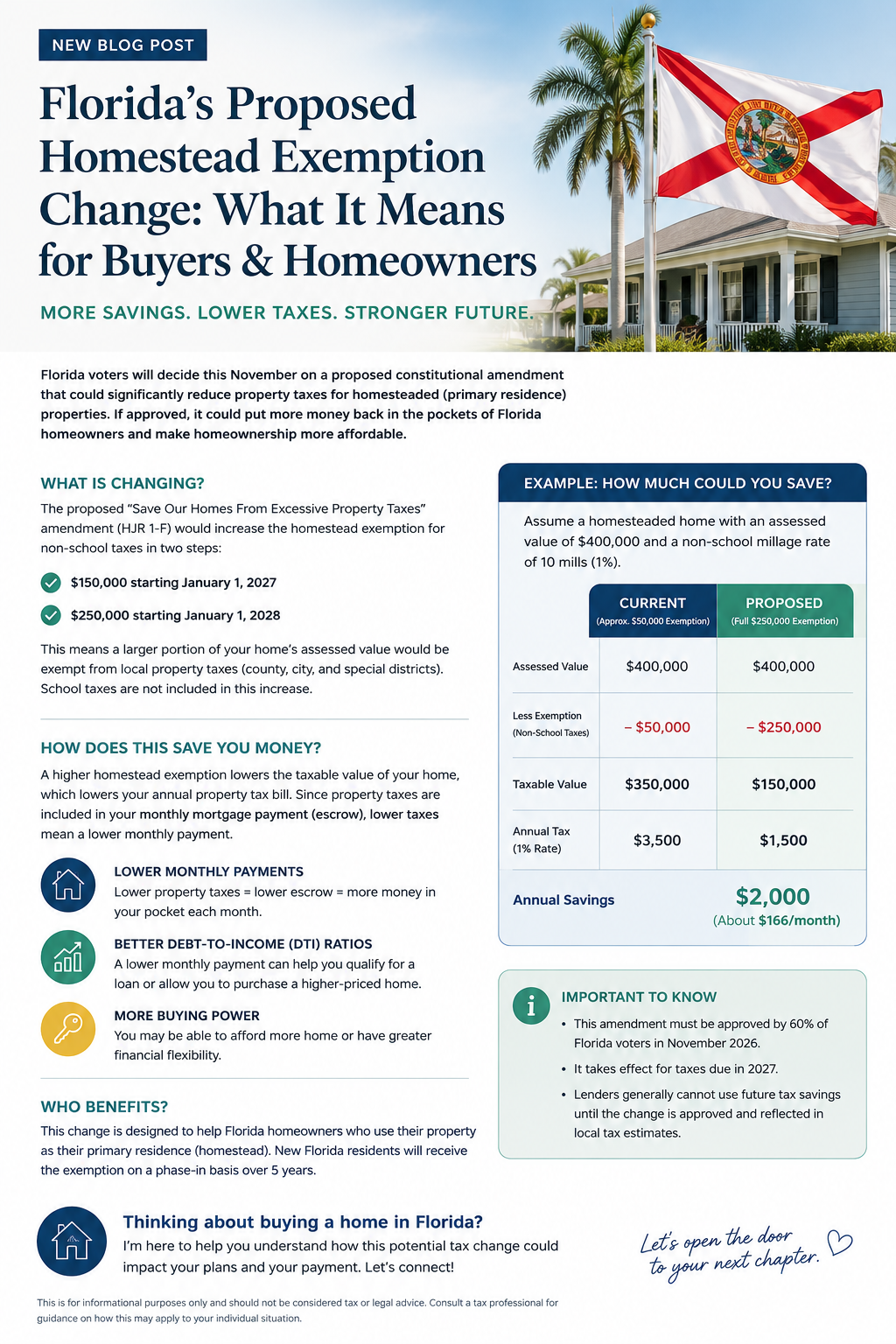
If approved, the proposed amendment would increase the homestead exemption for the non-school portion of property taxes. According to Florida Realtors, the exemption would increase to $150,000 on January 1, 2027, and then to $250,000 on January 1, 2028. Future inflation adjustments would begin after that.
This means a larger portion of a homesteaded property’s assessed value could be removed from certain city, county, and special district taxes. School taxes would not receive the full expanded exemption, so homeowners would still need to account for school district taxes in their total property tax bill.
How Could This Save Buyers Money?
The savings come from the property tax portion of the buyer’s monthly housing payment.
When a buyer has a mortgage, the monthly payment is usually more than principal and interest. Many buyers also pay escrow, which includes property taxes and homeowners insurance. A lower property tax bill can mean a lower monthly escrow payment.
For example, assume a buyer purchases a Florida primary residence with a taxable assessed value of $400,000.
Under today’s general structure, the buyer may receive around $50,000 in homestead exemption benefit, depending on the property and applicable taxes.
That could leave approximately $350,000 of taxable value for certain tax calculations.
If the proposed exemption eventually increased to $250,000 for non-school taxes, the taxable value for those non-school taxes could be reduced to approximately $150,000.
That is a $200,000 difference in taxable value for the non-school portion.
If the applicable non-school millage rate were around 1%, that could equal roughly $2,000 per year in potential tax savings, or about $166 per month.
This is only a simplified example. Actual savings would depend on the county, city, school district, special districts, assessed value, exemptions, millage rates, and whether the homeowner qualifies for homestead.
Why This Matters for Mortgage Qualification
For buyers using financing, property taxes affect more than the tax bill. They also affect mortgage approval because lenders look at the full housing payment.
That full payment is often called PITI:
Principal
Interest
Taxes
Insurance
If the tax portion of the payment is lower, the buyer’s total monthly payment may also be lower. That can help improve the buyer’s debt-to-income ratio, commonly called DTI.
A lower DTI can sometimes help a buyer qualify more comfortably, especially if they are close to the maximum allowed ratio for the loan program.
For example, if a buyer’s estimated property tax escrow drops by $150 to $200 per month, that may help offset higher insurance costs, interest rates, or other monthly debts.
Could This Increase Buyer Purchasing Power?
Potentially, yes.
A buyer’s purchasing power is tied to monthly payment, not just purchase price. If property taxes are lower, the same buyer may be able to afford a slightly higher purchase price while keeping the monthly payment within their qualifying range.
However, buyers should be careful not to assume the savings before the law is approved and reflected in tax calculations. Mortgage lenders generally underwrite based on current tax data, current estimates, and agency or investor guidelines. Until the change is officially approved and implemented, buyers should not rely on future tax savings to qualify.
Who Would Benefit Most?
The biggest potential benefit would likely be for Florida homeowners who use the property as their primary residence and qualify for homestead.
This may include:
Existing Florida homeowners with homestead exemption
Move-up buyers purchasing a new primary residence
First-time buyers purchasing a Florida homesteaded property
Retirees and fixed-income homeowners trying to reduce monthly housing costs
Buyers who are close on debt-to-income ratio
The proposal may not benefit everyone equally. Investors, second-home owners, and non-homestead properties would not receive the expanded homestead exemption, although the proposal also includes a lower annual assessment cap for some non-homestead and commercial properties.
What About New Florida Residents?
One important detail is the phase-in for new residents. Florida Realtors reports that property owners who are not permanent Florida residents as of December 31, 2026 would receive a phased-in exemption structure before reaching the full benefit after five years of residency.
That means someone moving to Florida after the cutoff date may not receive the full expanded exemption immediately.
What Buyers Should Do Now
Buyers should continue to look at affordability based on today’s numbers. That includes current tax estimates, homeowners insurance, flood insurance if applicable, HOA or condo fees, and the full monthly mortgage payment.
This proposed change may become a meaningful affordability benefit in the future, but it should be treated as a potential savings opportunity, not a guaranteed payment reduction.
A buyer who is shopping now should ask:
What are the current property taxes?
Will I qualify for homestead exemption?
What could taxes look like after purchase?
Does the property have CDD, special assessments, HOA, or condo fees?
How will taxes and insurance affect my monthly payment?
Am I close on DTI, or do I have room in my qualifying numbers?
Final Takeaway
Florida’s proposed homestead exemption expansion could help many buyers and homeowners by lowering the taxable value of a primary residence for certain non-school property taxes. If approved and implemented, that could reduce annual property taxes, lower monthly escrow payments, and help some buyers qualify more comfortably.
The key point is this: the proposal does not reduce the purchase price of a home, but it may reduce the cost of owning the home each month.
For buyers, that monthly savings can matter. In today’s market, even a $100 to $200 reduction in escrow can make a meaningful difference in affordability.
Disclaimer: This article is for general educational purposes only and is not tax, legal, or mortgage underwriting advice. Property tax savings vary by county, property value, exemptions, millage rates, and individual eligibility. Buyers and homeowners should confirm details with their county property appraiser, tax professional, and mortgage professional.
Categories
Recent Posts